Impressment – SoCS May 28/16

IMG_2269

The pressgang pillaged our hamlet. We women, we thought we would be safe. We thought our men would be safe.

We were wrong.

I could not let them take him, my brother. he was too weak, too young, too necessary to keep Mother company. I could be spared, I could adapt. Dickon could not. He was Mother’s favourite, she and I were too different. Not a day would pass when we did not bicker, when I tended the crops one way, and she would undo all my handiwork. I could not stitch or spin or weave to her satisfaction. Dickon – he knew how to manage her, he could do all the things that I failed at so miserably.

I dressed as a boy, looked like a man, and the men of the impressment took me.

I am here now, aboard HMS Magnanime, about to go into battle with the French, yet again. I am slight, I am nimble, I can ascend to the very top of the highest mast and not succumb to the pull of the sea. I am the youngest, the best, so says the captain.

I am homesick. I am seasick. But I am glad.


Her’s this week’s entry into the lovely Linda’s Stream of Consciousness Saturday prompt, where she has asked us to use the word ‘press’, either on its own or as part of a word beginning or ending with press as our inspiration.

The British Royal Navy was in the habit of using pressgangs to forcibly recruit people into service. For non-officers, there was no real concept of choosing a life at sea in service as a career, so the pressgangs (formally the Impress Service) would scour the country to select suitable men. Contrary to popular legend, they did not have the power to recruit anyone other than seafarers. But why let the truth get in the way of a good story!

Please do take part in Linda’s weekly prompt – you never know what will come into your mind! Please also pop along to read other entries – they will be many and varied!

socs-badge-2015

Cancelled stamp* – SoCS May 21/16

IMG_1559

Morning break was always Ella’s favourite snippet of free time. It lasted fifteen minutes, so Mrs Fothergill had told her, showing her what that looked like on the grandfather clock standing at a perilous yet comforting lean in the schoolroom. Its left feet were on a firm footing, planted on the red, cream and not quite navy blue diamond Victorian floir tiles, its right feet touching nothing but thin air, hovering above that place where the neighbouring tiles had mysteriously disappeared long ago.

Fifteen minutes, one quarter of the way around the dial with its smiling sun and moon faces painted perfectly in the middle of the Roman numerals. Fifteen minutes was just about long enough for her to watch the other children running round and round, the boys arms outstretched pretending to be one of those marvellous new aeroplanes or, every now and again, chasing after Polly, the prettiest girl in the whole school. All they wanted was to be in her presence, bask in one of her glowing, all-encompassing smiles.

All Ella wanted was to watch. She didn’t want the attention of the boys or the other girls, for that matter. She didn’t want to face their obvious delight at her threadbare blouse, her skirt with the pocket that was obviously a patch meant to disguise a hole that could no longer be darned, her shoes that had been soled and heeled beyond the life of the cracked and worn leather, her stockings that should have seen the bin last winter. Worst of all, she had no coat, no scarf, no gloves. She wore the same clothes season upon season. She was poor.

Miss Fothergill watched Ella hovering in the shadow of the schoolhouse wall, knowing without being told that the little girl was trying to soak up any warmth that might be seeping between the bricks at the back of the fireplace, where the coal fire burned merrily indoors to keep the schoolroom warm. She wondered if she could find a coat to fit the poor child, alter one of her own even, but knew it would be in vain. Mrs Adams (and everybody knew that she’d never been married in her life, everyone knew that Ella had been, as some more kindly put it ‘an accident’) was far too proud to accept. Miss Fothergill sucked her teeth in momentary disapproval at Ella’s plight and shook her head. She supposed the little girl would have to learn. Life wasn’t going to improve that much for her, given her wretched start in life.

Such a shame. She really did deserve a break.


Hello! Welcome to my entry this week to the lovely Linda’s Stream of Consciousness Saturday, where we were invited to use break/brake as our inspiration.

Do you know what I love about these prompts? I have absolutely no idea what Im going to write until I’ve tapped out the first few words, and even then, the end is rarely what I thought it would be when I first began! It’s so much fun.

Please do consider taking part, or at the very least hop on over to Linda’s blog and enjoy the writing – our entries are in the Pingbacks at the bottom.

*And in case you were wondering, ‘cancelled stamp’ was 1920s slang for a shy, lonely female, a wallflower. I think it’s quite sad.

socs-badge-2015

Under Pressure – Daily Prompt

2395336559_bd198602c0_b

You could tell, just by looking at them that they were all of the same bloodline.Same open expression, same physique, same tilt of the head when listening with undivided attention. You could be forgiven for thinking that they weren’t quite human, really. Someone, somewhere, had possessed incredibly strong genes.

So, time passed and everyone knew what to expect of the Meyers. You’d met one, you’d met them all, so it was said. It almost became folklore, that saying.

But then, then The Tragedy happened. And then, then their individuality was revealed in all its, well, unique glory, despite the circumstances.

Mother was a rock. She was the one they all turned to, the one they leaned on, the one that remained calm in the face of unspeakable horror.

Father broke. He wouldn’t, or couldn’t stop telling everyone how horrible everything was, how they would never recover, how he couldn’t see a way back from the edge. In short, he just wouldn’t shut up.

Granny remained in her rocking chair, demanding tea and toast and a drop of sherry in the evening as if nothing had changed. To be fair, she was as deaf as a post and impervious, so for her, nothing had changed really.

The Children, normally squabbling over the slightest perceived wrong, united, held fast to and supported one another as if sensing that they were stronger together. As a unit, they kept away from Father, not wanting his instability to puncture their carefully crafted strength.

And Sister? Oh she was the sly, crafty one in all of this. Like Janus, she had two faces, the dutiful daughter to all intents and purposes when she was being watched. At nightfall, under cover of streets as mute and dark as the dead, she would slip out and take her chances with anyone that would give her the glad eye, young or old, man or woman. This was freedom and she feasted on it.

The Meyers? Each as individual as the flakes of snow settling on this iron earth. Don’t underestimate them. Especially Father. I don’t think he’s as cracked as he likes you to think.

Survival of the fittest, right?


Here’s my entry into the latest WordPress Daily Prompt – today’s word is Diverse. Please do check in here to read other entries – why not take part?

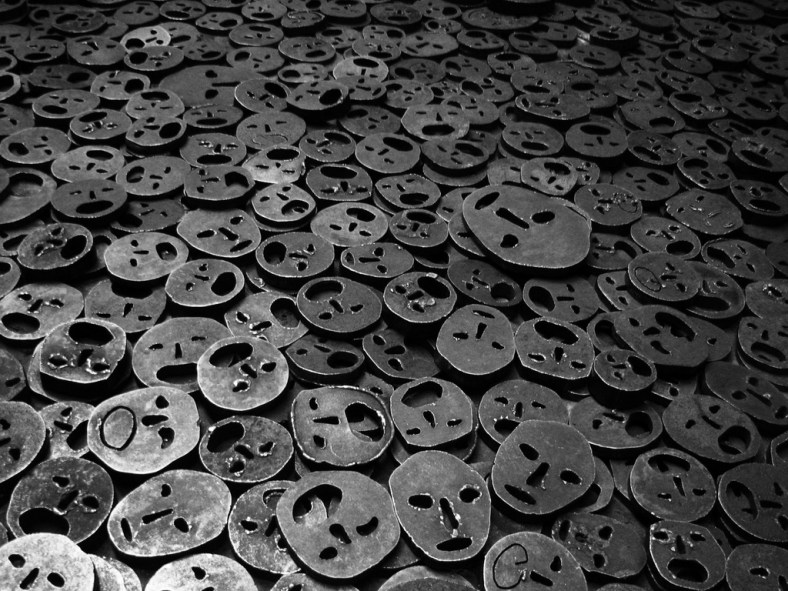
The image above is of an art installation in the Memory Void (one of the empty spaces in the Libeskind Buiding at the Berlin Jewish Museum). The installation was created by Menashe Kadishman and is called ‘Shalechet’ (Fallen Leaves). The steel faces (more than 10,000) are a memorial to the Shoah (Holocaust) and completely cover the ground. Visitors are asked to walk on the faces creating an eerie clanking sound.